Monday, 29 October 2018

Coconut (Cocos nucifera)


Everybody knows what a coconut tree looks like as we see them on TV all the time, but not everyone has seen one as it starts out in life. The first photo shown here is of a coconut that has fallen onto the ground, dried out over a period of months and is now sprouting to become a coconut tree. Being that the coconut can float, it can travel great distances on the water before coming to rest on dry land and then sprouting to become a new tree. Nature is pretty amazing, isn’t it.


The second photo shows a bunch of coconuts still on the tree, some of which are ready to be picked. As you can see, not all “water coconuts” (as we call them when they are ready) are green in colour as these yellow/golden varieties are also quite common on the island. At this stage, the coconut contains coconut water and usually some coconut jelly, though the amount varies significantly from tree to tree. So after the water has been drained out of the nut, it can be cut open and the jelly scooped out for consumption straight from the nut. Depending on the ripeness of the coconut, the jelly can vary from very soft to relatively firm, and it tends to have quite a strong coconut flavour. Coconut that has been grated and used in cooking comes from a coconut that has dried sufficiently that the outer shell is completely brown, and most of the water has been absorbed to become dry coconut suitable for grating.


The third photo is self explanatory - a lovely coconut tree framing part of the south coast of Barbados at sunrise. So really coconuts are pleasing on the eye and the palate. Enjoy!


Monday, 22 October 2018

Butterflies Everywhere


This year again we have had a multitude of wonderful butterflies of all colours and sizes. This is just one of the many shown in these photos. I was lucky enough to snap this as it settled on a Silver Dollar bush in the east of the island, but there were so many others that I was just not quick enough to get.

Some are just tiny, with a wing span of about 5/8” with pale yellow wings or pale lavendar wings and even darker brown wings. They seemed to come out of the ground cover in clouds as I walked through various “weeds”. 

We’ve also had lots of the slightly larger almost white butterflies, pale yellow, a magnificent buttery yellow and even golden yellow, but these seem to be slightly less abundant. I have a white sage plant in a pot on my deck where I can sit and watch them come and go as they feed on the nectar of these flowers. I’ve also seen them in abundance on yellow sage, pink sage and just about any colour sage shrub.


My garlic chive that is flowering profusely also seems to be very appealing to some of the butterflies, particularly the ones shown here. If you really want to see our local butterflies, you will need to take a drive past areas that are not quite as developed and built up and therefore with more “bush” and uncultivated spaces.


Monday, 15 October 2018

Creeping Jenny


Most people think of Creeping Jenny as a weed and work assiduously to remove all signs of it from their garden, however, it is perfect for areas where there is little or no soil, and it is hardy enough to grow in more windswept and salty conditions.

The flowers are actually quite small, about five eighths of an inch in diameter, but a carpet of bright yellow flowers and verdant green leaves is quite spectacular. It can’t be seen in these photos, but Creeping Jenny will even grow over solid rock where there are only tiny little pockets of soil, and it thrives.

Being so hardy, it requires no care at all other than, perhaps, to cut it back a bit if it spreads too far. In the dry season, it thins out, but as soon as the rains come, it spreads and flowers and is really quite delightful. An added bonus is that it is particularly attractive to a variety of butterflies and bees too.

Creeping Jenny can be found growing in abundance on and near the cliffs of the east and northern parts of the island.


Wednesday, 18 March 2015

Wild Tamarind


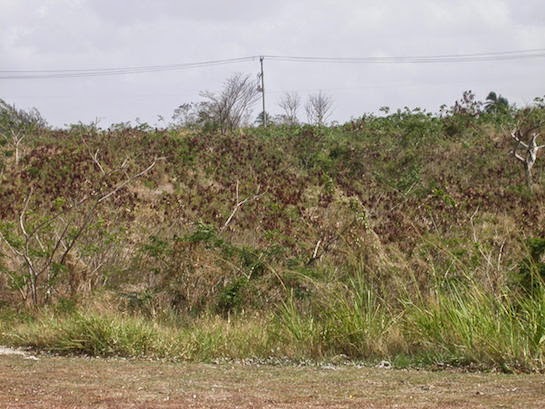
As the name suggests, Wild Tamarind grows wild all over Barbados. The leaves look like those of a tamarind tree, and it produces bean-like seed pods - a lot less fleshy than those of a tamarind though. The flowers are pretty little white puff balls that only last a day and are best seen early in the morning.


I’ve seen parrots and sparrows (bullfinches) feeding on the green seed pods and the new leaves, so lots of people that keep birds will pick them as a free food source for their birds. I’ve also seen monkeys eating the new seed pods and the young leaves (their salad).

As the seed pods ripen, they get hard and turn dark brown, and once they burst and the seeds are dispersed, they spring up into new plants very quickly.


The roots of the Wild Tamarind go quite deep into the ground, so once they are established, they can be quite difficult to get rid of. If left alone, they will grow into small trees, and it is not uncommon to see a thick wood of Wild Tamarind trees growing wild around Barbados.


If you’d like to read more about Barbados, please read my other blog, Things Barbados.

Monday, 23 February 2015

Reef Life in Barbados


When people think of Barbados, the first thing that comes to mind is not usually fabulous reefs and marine environments, however, there is a lot to look at and it’s improving all the time as steps are taken to preserve our reefs.

I visited the Drill Hall Beach (on the south coast) recently at low tide and was so amazed at how much there was to see on the reef without getting my feet wet. This would not have been the case at high tide.


There were all sorts of well camouflaged tiny fish that were the colour of the sand, but if you looked closely you could spot one darting under a rock. I saw sea urchins, sea centipedes and sea spiders and, to my untrained eye, they all seemed healthy.

I did not go in the sea, but I am quite sure that if I were suitably attired and donned my snorkeling gear, I would have been equally impressed with what I saw on the reef further from shore.


If you’d like to read more about Barbados, please visit my other blog, Things Barbados.

Thursday, 19 February 2015

Seaside Plants & Trees in Barbados


Being a small island, much of the vegetation that flourishes on Barbados has a bit of tolerance to salt as you can never be too far away from it. Visit any beach and mahoe trees, manchineel trees and seagrape trees are in abundance. On more arid and windswept parts of the island and right on the beach, seaside morning glory, milkweed and coarse grasses thrive.


Most of these plants are quite harmless, but manchineel is very poisonous. Sheltering under one of these during rain (or afterwards when it’s still dripping) will result in blistering of the skin. The tree produces small apple-like fruit that you shouldn’t even touch. Manchineel trees are particularly common on west coast beaches, but they are usually labelled in some way - a red stripe or an ‘X’ to indicate that it is poisonous.


Casuarina trees and wild geranium are also fairly hardy and thrive in drier windier locations with some salt thrown in. Though these trees and plants can be found inland, they are more frequently found in coastal areas, especially areas that are a bit wild, as other plants will suffer in the saltier environment.


If you’d like to read more about Barbados, please visit my other blog, Things Barbados.

Wednesday, 4 February 2015

Asparagus Fern

Asparagus Fern (Asparagus setaceus) grows wild all over Barbados, particularly at higher, moister elevations, and with a bit of shade. It’s commonly used by florists in flower arrangements, so is in high demand.


Asparagus fern has a very delicate structure and is not actually a fern at all. As far as I know it is used strictly for decorative purposes, and if allowed to grow unrestricted, it can become a huge plant.

The stems are quite tough and there are thorn-like protuberances at regular intervals which makes handling the plant a delicate matter - gloves are a good idea. Simple small green berries are produced, which darken with age, and become almost black in colour.

Asparagus Fern (Asparagus setaceus) does not grow well in direct sunlight, and if cuttings are placed in water, they will remain green for quite a long time. Alternatively, they will dry out very quickly and turn brown if allowed to dry out.


If you’d like to read more about Barbados, please visit my other blog, Things Barbados.