Thursday, 19 February 2015

Seaside Plants & Trees in Barbados


Being a small island, much of the vegetation that flourishes on Barbados has a bit of tolerance to salt as you can never be too far away from it. Visit any beach and mahoe trees, manchineel trees and seagrape trees are in abundance. On more arid and windswept parts of the island and right on the beach, seaside morning glory, milkweed and coarse grasses thrive.


Most of these plants are quite harmless, but manchineel is very poisonous. Sheltering under one of these during rain (or afterwards when it’s still dripping) will result in blistering of the skin. The tree produces small apple-like fruit that you shouldn’t even touch. Manchineel trees are particularly common on west coast beaches, but they are usually labelled in some way - a red stripe or an ‘X’ to indicate that it is poisonous.


Casuarina trees and wild geranium are also fairly hardy and thrive in drier windier locations with some salt thrown in. Though these trees and plants can be found inland, they are more frequently found in coastal areas, especially areas that are a bit wild, as other plants will suffer in the saltier environment.


If you’d like to read more about Barbados, please visit my other blog, Things Barbados.

Wednesday, 4 February 2015

Asparagus Fern

Asparagus Fern (Asparagus setaceus) grows wild all over Barbados, particularly at higher, moister elevations, and with a bit of shade. It’s commonly used by florists in flower arrangements, so is in high demand.


Asparagus fern has a very delicate structure and is not actually a fern at all. As far as I know it is used strictly for decorative purposes, and if allowed to grow unrestricted, it can become a huge plant.

The stems are quite tough and there are thorn-like protuberances at regular intervals which makes handling the plant a delicate matter - gloves are a good idea. Simple small green berries are produced, which darken with age, and become almost black in colour.

Asparagus Fern (Asparagus setaceus) does not grow well in direct sunlight, and if cuttings are placed in water, they will remain green for quite a long time. Alternatively, they will dry out very quickly and turn brown if allowed to dry out.


If you’d like to read more about Barbados, please visit my other blog, Things Barbados.

Tuesday, 27 January 2015

Shagga Crab


I don’t know the real name for this crab, but I’ve grown up knowing it as a Shagga. It’s a saltwater crab found on rocks all around Barbados.

As you can see from the photograph, the Shagga crab’s camouflage is outstanding. It’s easy to look at a rock and miss it completely unless the crab moves.

You can go to any beach or cliff that’s on the water anywhere on Barbados, sit and watch closely, and you’ll see these crabs. They live on the rocks. I’ve never seen one swimming nor on the sand, so I think they live their entire life on rocks and cliff faces.


If you’d like to read more about Barbados, please visit my other blog, Things Barbados.

Thursday, 22 January 2015

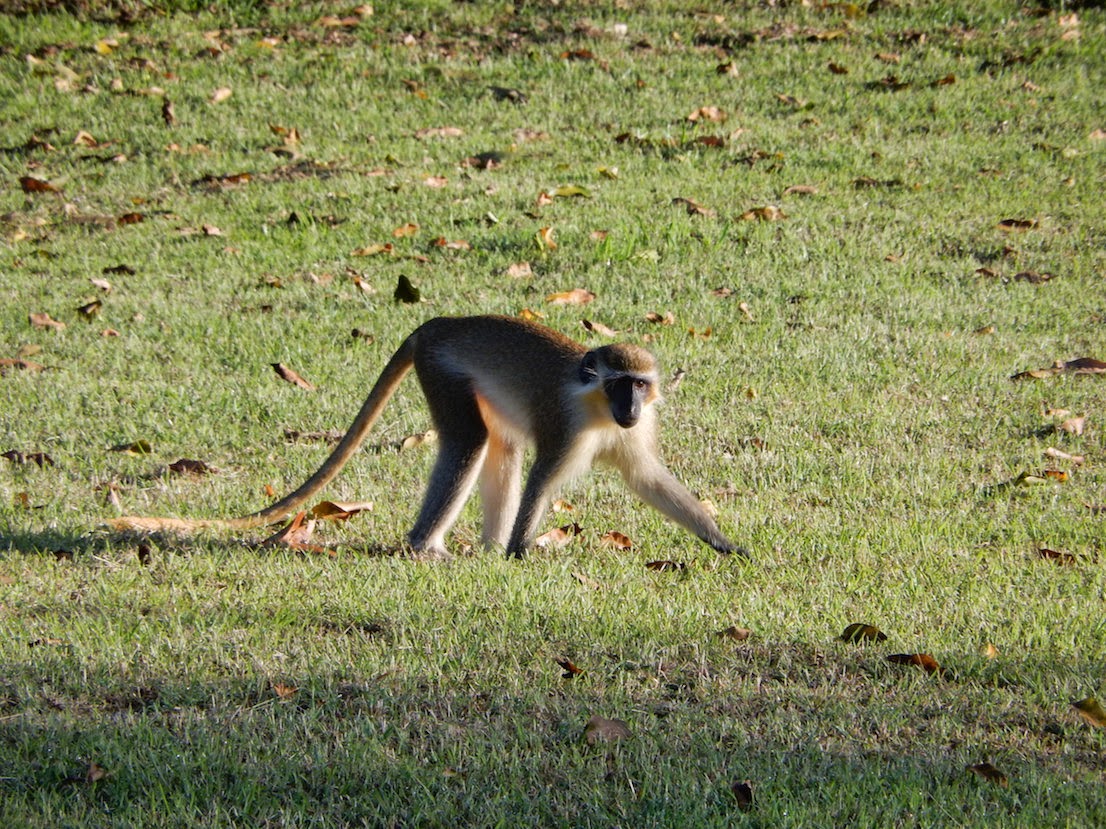
Barbados Green Monkeys


Saw this huge troop of Green Monkeys outside my back door a couple mornings ago. Don't think I've ever seen such a large troop, so it was pretty cool. Unfortunately they were too spread out for me to get a photo of the entire troop.


There were lots of juveniles, at least one very pregnant female plus others, and, of course, the dominant male. There were probably two dozen in all, maybe more. They didn't stick around for very long, but long enough for me to enjoy them and their frolicking.

Things have started to dry up a bit on the island, so monkeys are having to roam further afield to find food and water - this is when fruit trees take a hit.


I love being able to watch them at such close quarters, but I wouldn't mind at all if they didn't poop on my deck.

If you'd like to read more about Barbados, please visit my other blog, Things Barbados.

Thursday, 15 January 2015

Seaside Morning Glory


Seaside Morning Glory is a hardy vine that grows on the beach and other salty windswept environments all around Barbados, but particularly on the north, east and south-east coasts of the island. The vine grows very quickly and can overtake an area if allowed to get out of hand.


The leaves are thick and hardy, but the flowers are very delicate. They are at their best early in the morning, and have wilted by afternoon. The seaside morning glory is good for helping to hold the sand on the beaches and though it will die off a bit in dry weather, once the rains start to come, they grow rapidly, much like a weed.

The specimens shown in these photographs were found growing on rocky outcrops on the east coast of Barbados, areas seemingly devoid of soil.


If you’d like to read more about Barbados, please visit my other blog, Things Barbados.

Thursday, 18 December 2014

Broad Leaf Thyme


Broad Leaf Thyme is a herb that grows almost wild throughout Barbados. It is a favourite in local cooking, and is commonly known as “Poor Man’s Bacon” as in the old days, people would fry and eat it as you would bacon.

As the name suggests, the leaves can get quite big - easily three or four inches. The leaf is quite thick and meaty, and is covered in a fine downy hair. The scent is strong and unmistakeable.

Broad Leaf Thyme is so easy to grow - just pop off a leaf with a bit of stem attached and stick it in the ground or in a pot. A bit of water here and there (not too much), and soon you will have a large healthy plant that will continue to spread if left untrimmed.

This variety of thyme is used liberally in local cooking, usually mixed with other herbs, salt, black pepper and probably some local hot peppers too. Everything gets chopped up together into a fine paste before being added to the pot or being used to marinate meat prior to cooking.


If you’d like to read more about Barbados, please visit my other blog, Things Barbados.
Tuesday, 9 December 2014

Christmas Flowers Are Blooming

It’s that time of year again when the flowers that come out at Christmastime are blooming.


The bright yellow Christmas Candles have been flowering for a month or so already. They are in gardens plus they grown wild, particularly in the drier parishes of St Lucy and St Phliip. A Christmas Candle in full bloom is truly spectacular.


All over the world the Poinsettia plant is associated with Christmas. Here, in Barbados, it is the time year when these shrubs are covered in vibrant red - the actual flowers are tiny white or pale yellow structures surrounded by bright red sepals.

The only Poinsettia plants that would be found indoors are the imported hybrids that are specifically used for decoration inside at this time of year, and then they die off after a few months.

I haven’t actually seen any Poinsettia outside yet that have turned red, and I seem to recall that they were quite late this year, but I’m sure we’ll see them soon.

Last but by no means least is the spectacular Snow on the Mountain. I haven’t seen any of these yet either, but they are hard to miss - a bright white shrub that really does look like a hill covered in snow.

If you’d like to read more about Barbados, please visit my other blog, Things Barbados.